
I know the sick feeling you get when you open a letter from the Internal Revenue Service (IRS). You see the big numbers. You instantly wonder: can you go to jail for not paying taxes? That fear is real. It is a fair question. After years in finance, I have heard this question a lot. The answer truly depends on just one key word: willful.
Yes, you can go to jail for not paying taxes. But this only happens if your failure is willful. This means you chose to break the law. You acted on purpose to avoid your known tax duty. A simple mistake or an inability to pay is not a crime. The difference between having a debt and committing a crime is huge. We need to look at the two types of criminal charges now. It is all about your intent.
The Crucial Difference: Why the IRS Cares About Your Intent
The IRS understands that life happens. People lose jobs. Businesses fail. You might have a huge medical bill and just can’t pay your taxes. In my experience, this is the most important part of the whole tax discussion. The IRS doesn’t want to jail the person who got hit with a bad year and simply can’t pay. They want the person who purposely hid money or lied on a form.
The Legal Line: Defining “Willfulness”
The law uses a powerful legal word here: Willfulness. This Legal Concept is the line between a mistake and a crime. The IRS defines willfulness as a “voluntary, intentional violation of a known legal duty.” It’s not about being bad at math or forgetting a form. It means you knew you had to pay, and you actively chose to break the law to avoid it. If your failure to pay is due to true hardship, that is a civil matter. If you knew you owed the money but then hid it, that becomes a criminal matter.
The Civil Path: What Happens When It’s NOT Willful |
| If you fail to pay due to a mistake or hardship, you face civil actions, not jail time. This is the most common outcome. The civil path brings Penalties and Interest on the amount you owe. The IRS will use its collection tools. These tools include wage garnishment, bank levies, or placing liens on your home. Even state and local agencies, like those dealing with property taxes or state taxes, mainly use these civil tools. Jail time for non-payment of property taxes is almost unheard of in the U.S. |
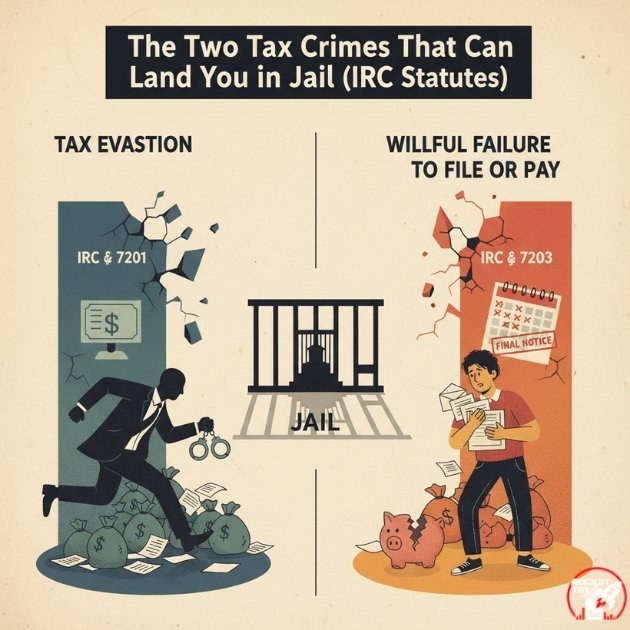
The Two Tax Crimes That Can Land You in Jail (IRC Statutes)
You now know that willfulness is the key that unlocks criminal charges. So, when can you actually go to jail for not paying taxes? The answer is found in the Internal Revenue Code (IRC). This is the official book of U.S. tax laws. The IRC names two main crimes for willful tax issues. They are a misdemeanor and a much more serious felony.
Felony Tax Evasion (The Big Dog: IRC §7201)
The most severe charge is Tax Evasion. This is the felony offense for a willful attempt to defeat any tax. Think of this as the biggest issue. It carries the highest risk of prison time. The key is proving you took an Affirmative Act to hide the money.
- What is an Affirmative Act? This Legal Concept means you did something active to evade the tax. It can’t just be that you failed to file. You must have taken a positive step to conceal things. My experience shows this might look like keeping two sets of books. It could also mean making false invoices or moving assets offshore.
- The Penalty: If convicted, you face up to 5 years in federal prison and a $100,000 fine. The IRS must prove you actively tried to cheat the system.
Misdemeanor Tax Crime (Willful Failure: IRC §7203)
The lesser, but still serious, crime is the Misdemeanor Tax Crime. This is for willful failure to file a tax return or willful failure to pay tax. This is a crime of willful omission—you chose not to act when the law said you must. If you willfully fail to file your federal taxes, you can go to jail for up to a year.
- The Difference: This is a less severe crime than Tax Evasion. Still, it is a serious criminal offense. It happens when you know the rules but simply ignore them.
- The Penalty: A conviction can mean up to 1 year in federal prison and a $25,000 fine. Even though it’s a misdemeanor, the result is still jail time.
✅ If you’re looking for professional Team Rocket Tax, our experienced team is here to help you maximize your returns. Contact
The Legal Precedent: How the Supreme Court Drew the Line
Knowing the difference between the misdemeanor (IRC §7203) and the felony (IRC §7201) is vital. But how does the IRS truly prove that line? The answer comes from the highest court in the land. The U.S. Supreme Court created the rule that defines when an honest mistake ends and a crime begins.
The core rule comes from the landmark 1943 case, Spies v. United States. This case set the legal standard. It made it clear how the government must prove you tried to evade taxes.
- The Spies Rule is the reason the IRS can’t just charge everyone who fails to file with a felony. The Supreme Court said that Tax Evasion requires an Affirmative Act. This means you actively did something wrong. It is a crime of commission.
- The Connection: The court clarified that a willful failure to pay is a willful omission (the misdemeanor). But to get a felony conviction, the government needs that extra step. They must prove you took an action to hide your income. This rule shows that the government must prove an action was taken to evade. This is why it is so rare to go to jail for not paying taxes unless you are actively hiding the money.
Addressing Specific Concerns (Taxes That Carry High Risk)
When people ask, “Can you go to jail for not paying taxes?” they often wonder about a specific type of tax. It helps to look at Federal vs State & Local Taxes and certain high-risk areas. The rules are much the same across the board. The key is still willfulness.
Federal vs State & Local Taxes
- Federal Taxes: These are handled by the IRS. They have the power to charge you with felony Tax Evasion or the Misdemeanor Tax Crime. The penalties are harsh.
- State & Local Taxes: Can you go to jail for not paying state taxes? Yes, you can. Many states have laws that mirror the Internal Revenue Code (IRC). If your failure to pay state income tax is willful, you can face jail time from state courts.
- Property Taxes: Can you go to jail for not paying property taxes? Almost never. Your city or county mainly uses civil tools. They place a lien on your property or even take it through foreclosure. Jail is not an option for non-payment of property taxes.
The Payroll Problem: Why Business Taxes Are High Risk
In my years of work, there is one area that acts as a major red flag for the IRS. This is the willful failure to remit business taxes. Specifically, this means payroll taxes and sales tax.
- Trust Fund Taxes: Payroll taxes are seen as “trust fund taxes.” This is money you took from an employee’s paycheck to give to the government. When you fail to remit it, the IRS views it as stealing from the government and your workers.
- The Takeaway: While non-payment of property tax rarely leads to jail, willful failure to remit payroll or sales tax is a top red flag. It is a very serious offense. If you chose to use those funds for your business instead of giving them to the government, that looks like willfulness. This greatly raises your risk of criminal investigation.
Pros & Cons: Civil Debt vs Criminal Intent
| Path/Issue | Pros (Better Outcome) | Cons (Worse Outcome) |
| Civil Tax Debt (Non-Willful Mistake/Hardship) | No Jail Time: You only face money penalties and interest. | Financial Loss: You still must pay the original tax plus Penalties and Interest. |
| Civil Tax Debt (Non-Willful Mistake/Hardship) | IRS Help: The IRS offers payment plans like Installment Agreements or Offer in Compromise. | Loss of Assets: The IRS can place a lien on your home or garnish your wages to collect the debt. |
| Criminal Intent (Willful Evasion) | Rare Charge: The IRS only targets a very small number of people who actively hide money. | Jail Time: You face possible federal prison time (up to 5 years for felony Tax Evasion). |
| Criminal Intent (Willful Evasion) | Criminal Record: A conviction means a felony or misdemeanor record, which impacts future jobs and life. | |
| Business Taxes (Payroll Problem) | Top Red Flag: Willful failure to remit payroll (trust fund taxes) is viewed as stealing and leads to a high risk of criminal investigation. |
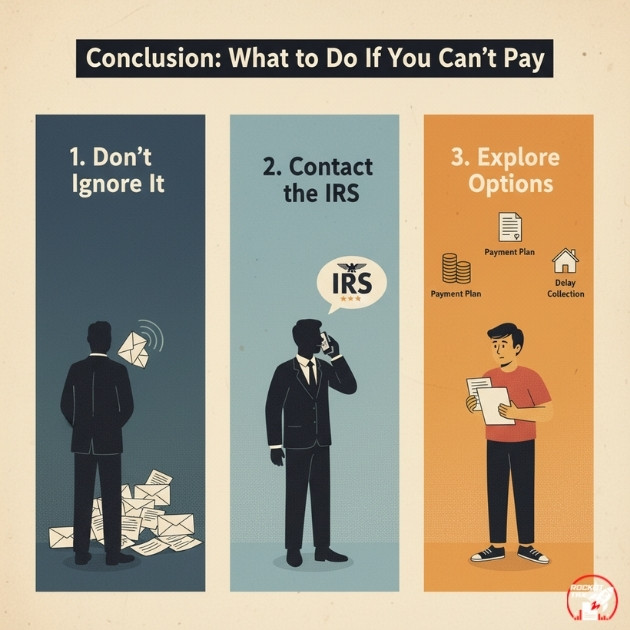
Conclusion: What to Do If You Can’t Pay
I know reading about felony charges and jail time can cause real stress. Please remember that panic is not the right step. The IRS mainly wants its money. It does not want to fill prisons with people who made an honest mistake. Your best tool is communication. Do not try to hide your income or assets. This action turns your debt into a criminal matter.
If you owe back taxes and truly cannot pay them, you must act fast. I strongly advise you to call a tax professional. You can also reach out to the IRS on your own. You need to set up a civil resolution before things get worse. The IRS offers programs to help. These include Installment Agreements or an Offer in Compromise. Take this step now. Avoid the serious risk of a criminal investigation.
FAQs: Quick Answers for Your Tax Worries
We’ve covered the complex legal line that decides if you can go to jail for not paying taxes. Now, here are quick, simple answers to the most common worries people have. This information should ease some of your fears.
-
Q: How much do you have to owe the IRS before you go to jail?
- A: There is no specific dollar amount that will send you to jail. The issue is never how much you owe, but why you owe it. The IRS only pursues jail time if your actions were willful, meaning you intentionally tried to evade taxes by hiding income or lying on a return.
-
Q: What happens if you just don’t pay taxes?
- A: If you just don’t pay, the IRS will first treat it as a civil debt. You will face interest and severe penalties (e.g., the failure-to-pay penalty). If you ignore their notices, they will use collection tools like liens, levies, and wage garnishment to get the money.
-
Q: How many people go to jail for not paying taxes?
- A: Very few people go to jail for merely not paying taxes. The IRS Criminal Investigation division is highly selective. They usually pursue only a few hundred convictions each year for serious tax crimes like Tax Evasion.
-
Q: How long can you not file taxes before going to jail?
- A: There is no set time limit like “three years” that automatically sends you to jail. If your failure to file becomes willful (a deliberate choice to ignore your known legal duty), the misdemeanor charge allows for up to one year in prison for each year you willfully failed to file.
At Rocket Tax LLC. we help clients across Florida understand where honest mistakes end and criminal risks begin. If you’ve missed tax payments or received a notice from the IRS, don’t wait until it escalates. Our experienced tax accountants in Orlando, can guide you through payment plans, penalty relief, and IRS negotiations — helping you stay compliant and avoid legal trouble.
Read More: